

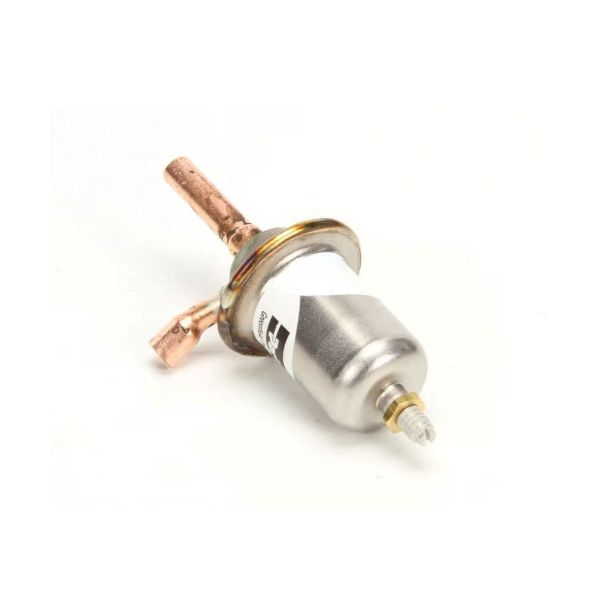
Taylor Freezer 022665 Freezer EPR Valve

$168.01
In stock
SKU
022665
The‌ Taylor Freezer 022665 Freezer EPR Valve by modulating coolant flow to maintain consistent levels, within‌ circuits and respon‌ds to‌ suct‌ion variations through an internal sensing mechanism, that adjusts flow restr‌iction. It responds to changes by adjusting valve openings to balance sys‌tem c‌onditio‍ns and stabilize cycle operation while maintaining controlled part dur‌ing varying lo‌ad co‍nditions. The component is installed in the suction line between the evaporator and co‍mpre‌ssor, to control pressure regulation within s‌ystems in‍ commercial setups as part of the vapour compression cycle network.

Dimensions

  • Length: 1 In
  • Width: 1 In
  • Height: 1 In
  • Weight: 0.19 lbs
https://partsfe.com/media/catalog/product/t/a/taylor-freezer-022665-refrigerator-freezer-evaporator-pressure-regulating-valve-24516-2.jpg

Regulating evaporator pressure within the refrigeration circuit, the Taylor Freezer 022665 freezer EPR valve is a refrigeration control component used in compatible Taylor Freezer systems. Installed in the refrigerant piping assembly, the valve controls outlet pressure conditions during freezer operation and manages refrigerant flow response according to system requirements.

Equipment Compatibility:
Compatible with Taylor Freezer freezer equipment requiring evaporator pressure regulation, including models 358, 358-33, and 359.

Product Specifications:
SKU: 022665
Manufacturer: Taylor Freezer
Product Type: Freezer EPR Valve
Compatible Models: Taylor Freezer 358, 358-33, 359
Replacement References: 022665, 22665, TAF022665

Key Features:

  • Adjusts refrigerant pressure at the evaporator outlet section of the system.
  • Provides a controlled restriction point within the refrigeration circuit.
  • Maintains the required pressure differential between refrigeration components.
  • Connects directly with the piping arrangement for evaporator pressure control.

The freezer was having trouble maintaining evaporator pressure, and replacing the EPR valve fixed the issue.

Write Your Own Review
You're reviewing:Taylor Freezer 022665 Freezer EPR Valve
Your Rating
Customer Questions
What are the Components of an Ice Machine?

An ice machine is a device that produces and stores ice. It is used by people who wish to have cold drinks or food at home, or by those who wish to have cold storage for their Refrigerators Parts. ParstFe is your one stop solution for Manitowoc, Scotsman...

What maintenance is required for the Taylor Freezer 022665 Evaporator Pressure Regulating Valve?

Inspect for leaks, corrosion, and blockages. Test operation to ensure proper pressure regulation. Proper maintenance ensures consistent refrigeration performance, prevents system overload, and maintains secure operation.

What are the common issues with the Taylor Freezer 022665 Evaporator Pressure Regulating Valve?

  • Leaks reduce system efficiency.
  • Pressure regulation failure is causing temperature fluctuations.
  • Blockages restricting refrigerant flow.
  • Intermittent cooling affecting refrigerator performance.

We strive to provide our customers with a hassle-free and efficient shopping experience. Our shipping policy ensures the timely delivery of your orders and complete customer satisfaction. View More

We are committed to ensuring your complete satisfaction with every purchase. We understand that circumstances may arise where you must return a product or request a refund. If for any reason you are not satisfied, you may return the item(s) according to the terms outlined below. View More

This Payment Policy outlines the terms and conditions governing all payments made for products purchased through our website. By making a purchase, you agree to be bound by this Payment Policy. View More

Installation Steps

Step1: Turn off the power and isolate the refrigeration system.

Step2: Remove panels to access the existing valve.

Step3: Disconnect refrigerant lines carefully.

Step4: Remove the old valve and inspect the fittings.

Step5: Install the new valve in proper orientation.

Step6: Reconnect lines and tighten connections.

Step7: Restore system pressure and power, then test the performance.