
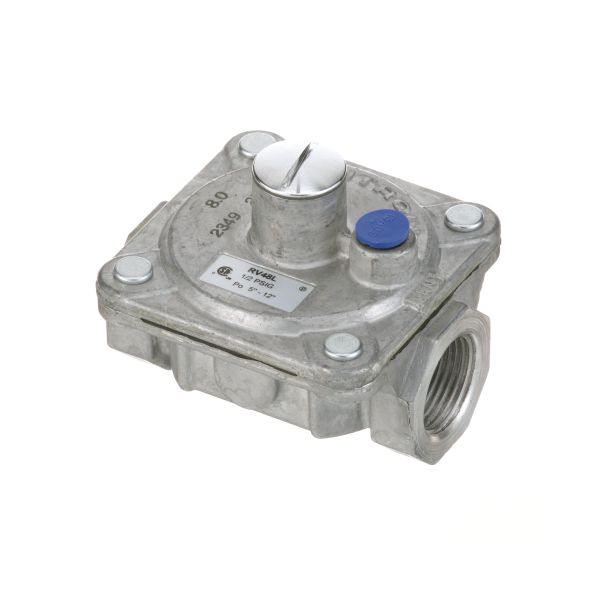
Royal Range 1619 Pressure Regulator 3/4" LP
Special Price $32.63 Regular Price $44.60
In stock
SKU
1619
Manufacturer:

The Royal Range 1619 Pressure Regulator 3/4" is a part that reduces the level of pressurization of LP gas entering the system to the desired operating levels for connected equipment while maintaining this pressure. Features an internal diaphragm, and valve system to control gas output during operation and to ensure a steady fuel delivery. It is typically used in commercial kitchen ranges, ovens and other gas-fired cooking equipment that require controlled LP gas pressure for proper system operation, and burner performance.
Dimensions
- Length: 3.5 In
- Width: 3 In
- Height: 3.5 In
- Weight: 0.8 lbs
Product Notes
- Lp Gas, 3/4" Fpt Gas In/Out, 5.5" - 12" Wc
- 1/2"Psi, 250,000 Btu, Maxitrol Rv48L-66-0033 Preset At
- Factory To 8.0
- American Range
- Bakers Pride Oven Where Applicable.
- Blodgett Oven Series: 900, 999, 1000, Bcg, Fa, Gzl.
- Garland Griddle Series: Gd
- Imperial Oven Ir,Ihr
- Keating Fryer Bb, Cc & Ts: 18" & Up.
- Southbend
- Oven Series: 300.
- Griddle Series: Sg Counter Top
- Vulcan Broiler, Grill, Warmer Where Applicable.
- Fryer 7594G, Oven Series 7000
- Range 24L, 36L/Lc, 48L/Lc, 148L/Lc, 60L/Lc/Lcc, 161L/Lc,