Compact Flooded Evaporators: Redefining Heat Transfer in Commercial Refrigeration
Commercial refrigeration systems depend on efficient heat transfer to maintain stable temperatures and protect temperature-sensitive products. The evaporator plays a key role by absorbing heat from the refrigerated space or cooling process and transferring it to the refrigerant.
Compact flooded evaporators are designed to provide effective heat transfer while using less space than many conventional evaporator arrangements. Their flooded configuration keeps the heat-transfer surface in close contact with liquid refrigerant, supporting efficient evaporation and cooling. This guide covers how compact flooded evaporators work, their heat transfer advantages, efficiency benefits, and key performance considerations.
What Are Compact Flooded Evaporators and How Do They Work?
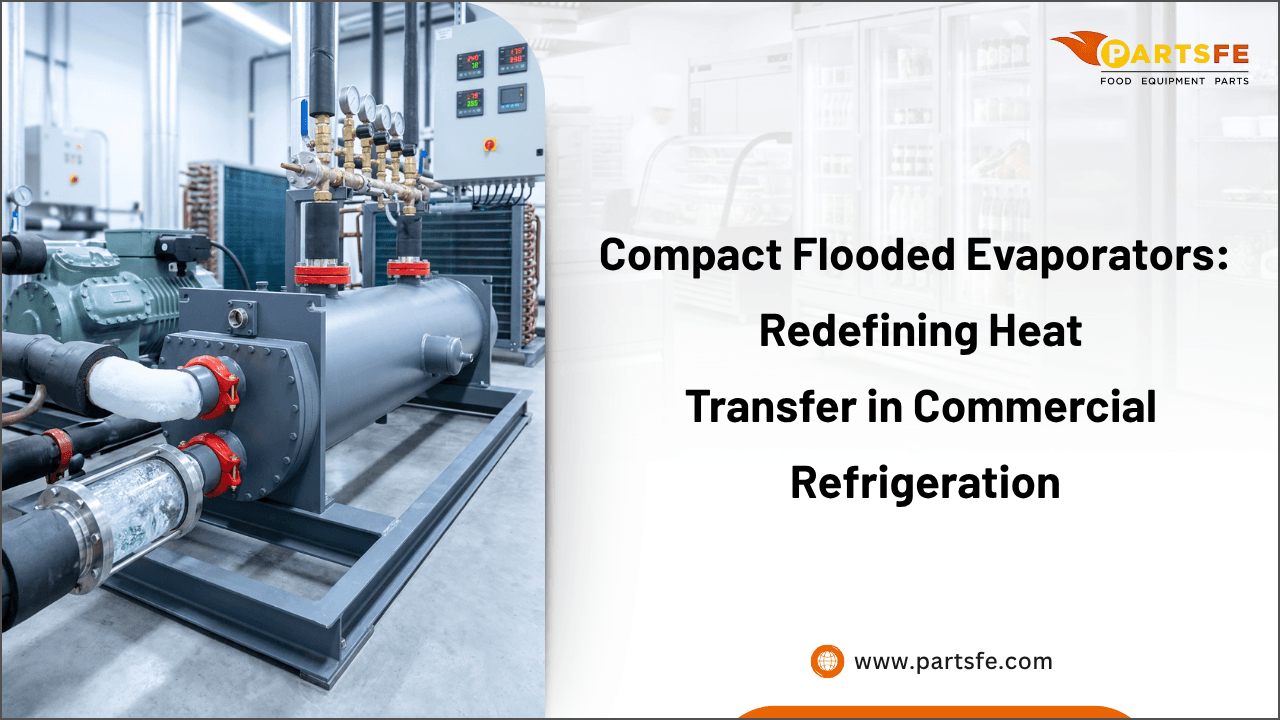
Compact flooded evaporators are refrigeration heat exchangers designed to provide efficient heat transfer within a relatively small footprint. They use liquid refrigerant to absorb heat from the surrounding air or a secondary cooling fluid as the refrigerant evaporates.
In a flooded design, the evaporator keeps much of its heat-transfer surface in contact with liquid refrigerant. This allows more of the surface to remain in contact with liquid refrigerant, supporting effective boiling and heat absorption.
The basic process works as follows:
-
Liquid refrigerant enters the evaporator and fills the heat-transfer area.
-
Heat passes into the refrigerant from the refrigerated space or cooling fluid.
-
The refrigerant absorbs heat and evaporates, changing from liquid to vapor.
-
Refrigerant vapor leaves the evaporator and travels toward the compressor to continue the refrigeration cycle.
This configuration can provide strong heat transfer while keeping the evaporator compact, making it suitable for commercial refrigeration systems where both cooling performance and available space are important.
Key Heat Transfer Advantages of Compact Flooded Evaporators
Compact flooded evaporators are designed to maximize heat transfer while keeping the equipment footprint relatively small. Their flooded operation keeps liquid refrigerant in contact with much of the heat-transfer surface, helping the refrigerant absorb heat effectively as it evaporates.
-
Better Use of Heat-Transfer Surface: The flooded design keeps a larger portion of the evaporator surface active during operation. This allows more of the available area to contribute to heat absorption.
-
Efficient Phase-Change Heat Transfer: Liquid refrigerant absorbs heat and changes into vapor through evaporation. This phase change enables effective heat absorption and supports efficient heat transfer within the evaporator.
-
Consistent Refrigerant Contact: Maintaining liquid refrigerant across the heat-transfer surface helps provide more uniform contact. This supports consistent heat absorption and reduces areas of the surface that may be underutilized.
-
Compact Heat-Transfer Design: The efficient use of the heat-transfer surface allows the evaporator to deliver useful cooling performance within a smaller footprint. This can be beneficial where commercial refrigeration equipment has limited installation space.
Overall, these advantages allow compact flooded evaporators to combine effective heat transfer with space-efficient construction for commercial refrigeration applications.
How Compact Flooded Evaporators Improve Commercial Refrigeration Efficiency
The heat-transfer characteristics of compact flooded evaporators can translate into practical improvements across commercial refrigeration systems. When the evaporator removes heat effectively, the system can respond more consistently to cooling demands, maintain target temperatures, and operate without unnecessary cooling effort.
|
Refrigeration Improvement |
How It Helps Commercial Systems |
|
Faster Heat Removal |
Helps remove heat efficiently when the refrigeration load increases. |
|
Stable Temperatures |
Supports consistent temperatures in storage and cooling spaces. |
|
Better Load Response |
Helps the system respond to changes caused by door openings, product loading, or process demands. |
|
Lower Compressor Workload |
Effective heat removal can reduce unnecessary compressor runtime under suitable operating conditions. |
|
Energy Savings Potential |
Efficient system operation can help reduce overall energy consumption. |
|
Space Optimization |
A compact evaporator design can provide cooling capacity while using less equipment space. |
Together, these improvements can help commercial refrigeration systems maintain cooling performance while using space and energy more effectively.
Key Design and Performance Considerations for Compact Flooded Evaporators
Compact flooded evaporators require careful design and operating conditions to achieve effective heat transfer. Factors such as sizing, refrigerant distribution, heat-transfer surfaces, and operating temperature can influence overall performance.
-
Proper Evaporator Sizing: The evaporator should match the required cooling load and operating conditions. Correct sizing helps provide the needed heat-transfer capacity without unnecessarily increasing equipment size.
-
Refrigerant Level and Distribution: Maintaining suitable liquid refrigerant coverage helps keep the heat-transfer surface in contact with refrigerant. Proper distribution supports consistent evaporation and heat absorption.
-
Enhanced Heat-Transfer Surfaces: Heat-transfer surface design plays an important role in evaporator performance. Enhanced surfaces, such as porous or metal-foam structures, can improve boiling heat transfer while supporting a more compact design.
-
Operating Temperature: The evaporating temperature affects heat-transfer performance and refrigeration efficiency. Suitable operating conditions help the evaporator meet cooling requirements effectively.
-
Refrigerant Charge: Compact flooded evaporators can be designed to reduce refrigerant requirements compared with larger conventional arrangements. Maintaining the appropriate charge is important for proper system operation.
-
Pressure Drop and Refrigerant Flow: Refrigerant flow and pressure drop should be considered when integrating the evaporator into the refrigeration system. Proper flow helps maintain effective heat transfer and system performance.
-
System Integration: The evaporator should work effectively with the compressor, condenser, controls, and other refrigeration components. Proper integration helps maximize the performance of the compact flooded design.
These factors help compact flooded evaporators deliver effective heat transfer while maintaining their space-saving and efficiency benefits.
Summary: Improving Commercial Refrigeration With Compact Flooded Evaporators
Compact flooded evaporators provide efficient heat transfer by keeping liquid refrigerant in contact with much of the heat-transfer surface. Their compact design can help commercial refrigeration systems achieve effective cooling while making better use of available equipment space.
By improving heat-transfer performance and supporting efficient cooling, compact flooded evaporators can contribute to stable refrigeration operation. Proper sizing, refrigerant management, and performance monitoring are important for maintaining these benefits.
Key Takeaways
-
Compact flooded evaporators provide efficient heat transfer.
-
Their design supports consistent commercial cooling.
-
Proper sizing helps match the required cooling load.
-
Regular maintenance helps preserve heat-transfer performance.
-
Worn valves, seals, sensors, and other components should be replaced when needed.
-
Proper refrigerant management supports long-term operation.
Looking for commercial kitchen equipment parts for repairs and maintenance? PartsFe offers replacement parts for refrigerators, ice machines, dishwashers, ovens, and more to help keep commercial kitchen equipment operating smoothly.
References:
https://www.energy.gov/documents/bto-peer-2021-novel-compact-flooded-evaporators-refrigerationpdf
FAQs
Where are compact flooded evaporators used?
They are used in various commercial refrigeration applications, including cold storage, food processing, and commercial cooling systems.
Do compact flooded evaporators help reduce energy consumption?
Efficient heat transfer can help the refrigeration system operate more effectively and reduce unnecessary compressor operation.
What maintenance do compact flooded evaporators require?
Regular cleaning, refrigerant checks, frost inspection, operating-condition monitoring, and inspection of connected components are important.
|
Disclaimer: This blog is for informational purposes only and provides general information about compact flooded evaporators, their benefits, performance, and commercial refrigeration applications. |